Synthesis
What synthesis actually does
Every synthesis method is a strategy for generating a spectrum that changes over time. Knowing which strategy you are using tells you which knob to reach for.
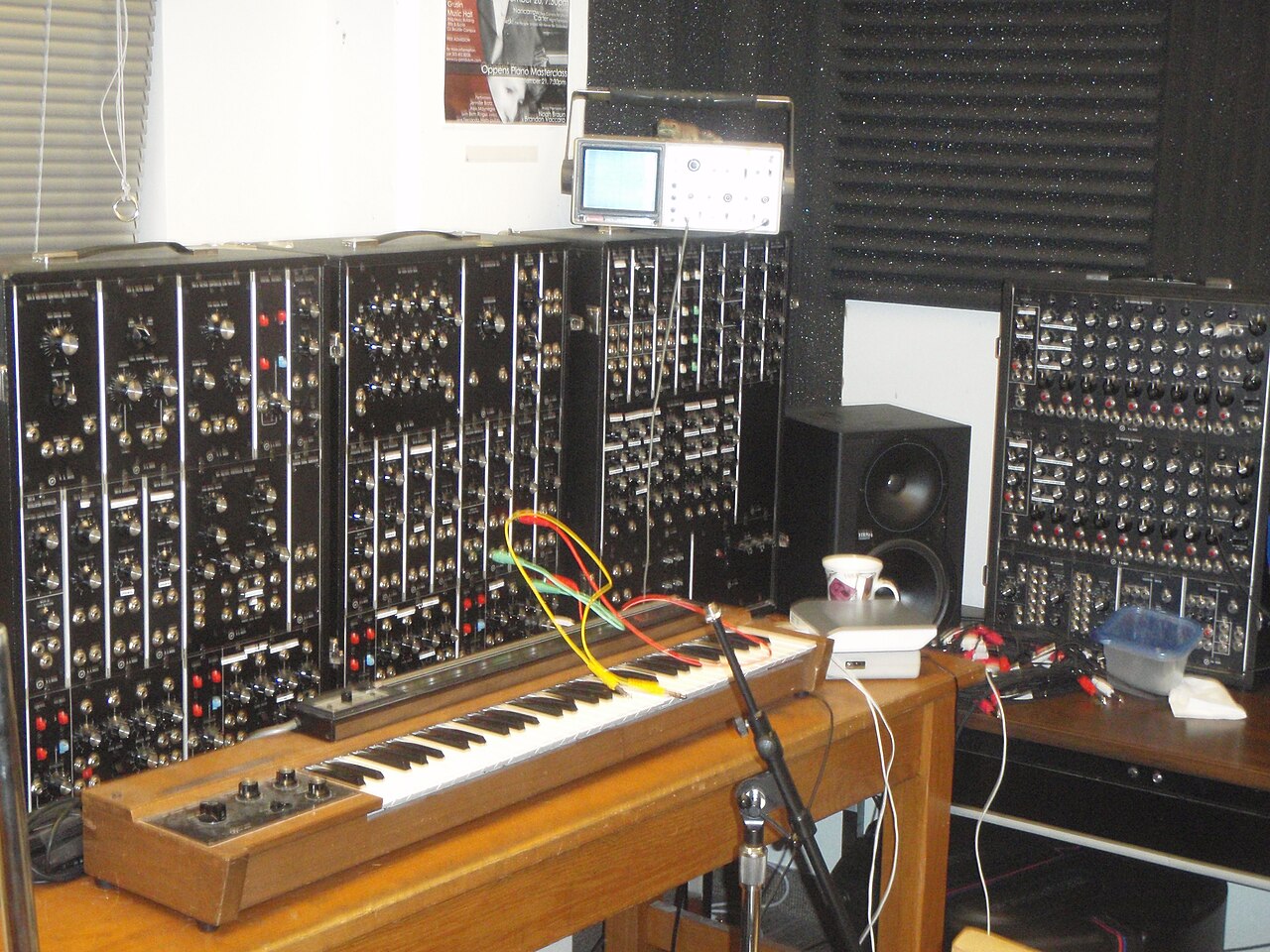
,_CRuNCh_Lab.jpg)
The shared problem
A musical sound is a spectrum that evolves over time. Every synthesis technique is a different strategy for producing one efficiently and controllably. The families differ in where complexity is introduced.
| Method | Strategy | Intuitive to control | Awkward to control |
|---|---|---|---|
| Subtractive | Start harmonically rich, filter away | Brightness, movement, envelope | Precise harmonic relationships |
| FM / phase modulation | Generate sidebands by modulating phase | Bell, metallic and evolving timbres | Predicting the result from parameters |
| Physical modelling | Simulate a vibrating system | Physically meaningful gestures | Sounds no object could make |
| Wavetable | Interpolate between stored spectra | Morphing and motion | Precise spectral targets |
Physical modelling in particular remains an active research area — work on simplified and controllable models of mode coupling [1] addresses exactly the tension between physical accuracy and playable control.
Why subtractive dominates
Not because it is most powerful — it is not — but because its parameters map onto perceptual dimensions people already have words for. Filter cutoff maps to brightness. Resonance maps to a nasal, focused quality. Envelope maps to attack and decay. You can predict what a change will do before you make it.
FM is more capable and far less predictable. Changing a modulator ratio can move a sound from bell to bass to noise with no perceptual gradient in between, which is why FM programming has a reputation for being learned by memorisation rather than by reasoning.
Synthesis and control mapping
Control is the real design problem
Research into digital instruments — including optical and gestural controllers [5] and sound generation in mechatronic systems [4] — is largely about mapping: how a performer's gesture connects to a synthesis parameter. That mapping determines expressiveness far more than the underlying method does.
The production equivalent is modulation. A static patch from a capable synthesiser is less interesting than a simple patch with well-chosen modulation, because what makes a sound feel alive is change over time, not spectral complexity at any instant.
Common questions
Which synth should I learn first?
Is analogue better than digital?
Why do my patches sound lifeless?
Do I need hardware?

Related reading
References
Every citation below links to the original peer-reviewed record on PubMed or via DOI. Nothing here is a substitute for medical advice.
-
A simplified and controllable model of mode coupling for addressing nonlinear phenomena in sound synthesis processes Poirot S, Bilbao S, Kronland-Martinet R · EURASIP Journal on Audio, Speech, and Music Processing · 2024 · Journal article DOI
-
Signal Processing for Image Morphing in Digital Image Synthesis Dr. Elena Martinez · American Journal of Signal and Image Processing · 2024 · Journal article DOI
-
Sound event triage: detecting sound events considering priority of classes Tonami N, Imoto K · EURASIP Journal on Audio, Speech, and Music Processing · 2023 · Journal article DOI
-
Exploring Sound Generation and Processing in Mechatronic Systems through Digital Signal Processing: A MATLAB-Based Investigation Wahhab M · Engineering and Technology Journal · 2023 · Journal article DOI
-
Optical Digital Theremin with Audio Synthesis and Graphic Interface Ramos dos Santos M, Coca Salazar A · International Journal of Circuits, Systems and Signal Processing · 2021 · Journal article DOI
-
Digital audio signal watermarking using minimum‐energy scaling optimisation in the wavelet domain Hsu C, Tu S, Yang C, et al. · IET Signal Processing · 2020 · Journal article DOI
-
Processing of volcano infrasound using film sound audio post-production techniques to improve signal detection via array processing Williams R, Perttu A, Taisne B · Geoscience Letters · 2020 · Journal article DOI
-
Sound effects without side effects—Suppression of artifacts in audio signal processing Case A · The Journal of the Acoustical Society of America · 2018 · Journal article DOI
-
Analysis by synthesis spatial audio coding Elfitri I, Shi X, Kondoz A · IET Signal Processing · 2014 · Journal article DOI
-
Digital removal of pulse‐width‐modulation‐induced distortion in class‐D audio amplifiers Aase S · IET Signal Processing · 2014 · Journal article DOI
-
Applications and implications of digital audio databases for the field of ethnomusicology: A discussion of the CNRS — Musée de l’Homme sound archives Khoury S, Simonnot J · First Monday · 2014 · Journal article DOI
-
Performance Analysis Of Haar Wavelets For Segmentation Of Heart Sound Bahekar L · i-manager's Journal on Digital Signal Processing · 2013 · Journal article DOI